

Pneumatic control performance depends on more than actuator size or supply pressure; the air passage connecting each component also influences how quickly a command produces movement. In automotive systems, excessive delay can affect the timing of pneumatic valves, positioning mechanisms, and other air-operated devices.
Selecting nylon air tubing with an appropriate internal diameter requires engineers to balance response speed, airflow demand, pressure loss, installation space, and material constraints. A larger bore can carry more air, but it also increases the volume that must be pressurized. Understanding this trade-off helps engineers specify tubing according to measurable response requirements rather than relying on diameter alone.
How Bore Diameter Changes Air Volume and Response Time
Internal diameter affects the amount of air contained within a tube. For a straight section of fixed length, the internal volume increases with the square of the bore diameter. A tube with a bore twice as large holds four times the air volume over the same length. Before an actuator can respond, the pneumatic circuit must establish the required pressure at the working chamber, so additional tube volume can increase the amount of air that must move through the line during a pressure change.
The relationship between bore size and response time is not simply linear. A narrow passage contains less air, which can reduce the volume required to pressurize the line, but its flow resistance is higher. Under demanding flow conditions, pressure loss across a small bore can restrict the rate at which air reaches the actuator. A larger passage reduces this restriction, yet its additional volume may slow pressure build-up if the supply valve and upstream circuit cannot deliver enough flow to fill it quickly. The effective design point depends on both tube geometry and the capacity of the surrounding pneumatic components.
Tube length adds another variable. Two systems with identical internal diameters can respond differently if one has a longer route between the control valve and actuator. Longer tubing generally adds internal volume and increases flow resistance, although the exact pressure behaviour depends on the operating pressure, flow rate, temperature, and circuit configuration. Engineers assessing nylon extrusion tubing for pneumatic circuits should evaluate the complete installed route, including bends and connectors, rather than treating the nominal bore as an isolated specification.
Balancing Airflow, Pressure Loss, and Actuator Demand
Actuator response requirements provide a practical starting point for diameter selection. A small pneumatic actuator with modest air consumption may operate satisfactorily through a relatively narrow bore, while a larger cylinder or a mechanism requiring rapid movement may need greater flow capacity. The relevant factors include actuator chamber volume, stroke, operating pressure, required cycle time, and the flow characteristics of the control valve. A tube that works under slow laboratory cycling may behave differently when the same mechanism is expected to repeat movements at a higher frequency.
Pressure loss deserves particular attention when the actuator operates near the minimum pressure required for its task. As air travels through the line, friction and local restrictions at fittings or connectors reduce the pressure available downstream. If the bore is too small, the actuator may build pressure slowly or fail to reach the intended operating force within the specified interval. Increasing the bore can reduce line resistance, but the improvement should be measured against the resulting increase in air volume. In some systems, reducing line length or relocating the valve closer to the actuator may offer a better response improvement than simply increasing tubing diameter.
A sound sizing process uses calculations to narrow the available options, followed by testing under representative operating conditions. Engineers can estimate tube volume from internal diameter and length, then assess expected flow demand and pressure drop using the system’s working pressure and valve data. Prototype testing should measure the interval between a control command and the actuator’s relevant pressure or movement threshold. Repeated tests at different supply pressures and cycle rates can reveal whether response time is limited by the tube, the valve, the actuator, or a combination of components.
Applying Diameter Selection to Automotive Tube Production
Automotive pneumatic installations often impose restrictions that affect the usable tube diameter. Tubing may need to pass through narrow spaces, follow a defined bend radius, avoid moving parts, and connect to existing fittings. A larger bore may improve flow performance but conflict with packaging limits or increase the external diameter needed to maintain the specified wall thickness. Engineers must also account for temperature exposure, vibration, assembly tolerances, and the mechanical properties required by the application. Diameter selection is most effective when hydraulic-style flow calculations are combined with practical packaging and durability assessments.
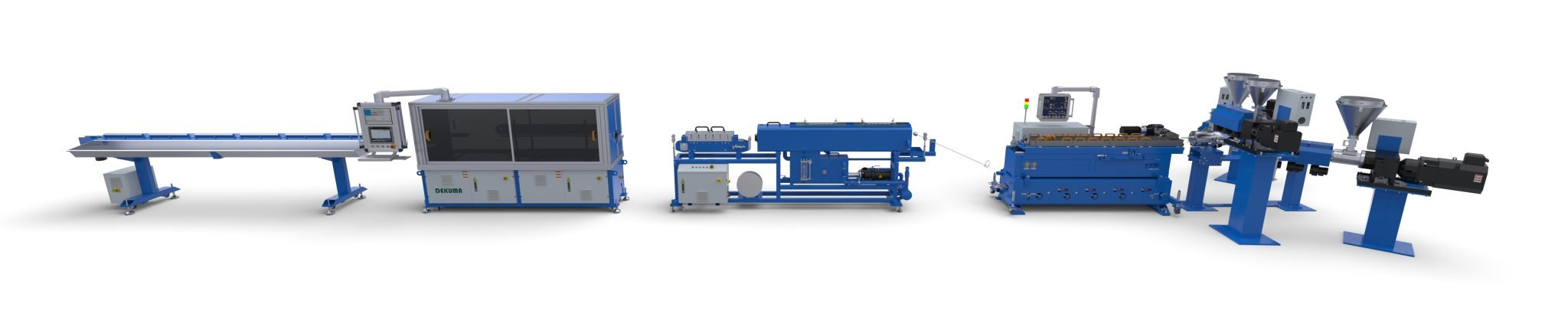
Manufacturing consistency matters because the specified internal diameter must remain stable throughout the production run. Variations in wall thickness, concentricity, and cooling conditions can affect the finished tube’s dimensions and mechanical behaviour. DEKUMA develops automotive plastic pipe extrusion equipment with features such as servo-controlled material delivery, a multi-layer composite die head, touchscreen process controls, ultrasonic wall-thickness inspection, and laser diameter measurement. These capabilities are relevant to dimensional control in automotive tube production, although the required configuration depends on the material, layer structure, and finished-tube specification.
Conclusion
Selecting a pneumatic tube bore is a system-level decision, not a contest to use the smallest or largest available diameter. A smaller passage may reduce the air volume that must be pressurized, while a larger one can support higher flow and reduce pressure loss; the correct balance depends on actuator demand, line length, supply conditions, and the required response interval.
Consistent nylon air tubing dimensions support repeatable assembly, while validated nylon extrusion processes help manufacturers maintain the specified geometry. With its automotive tube production and measurement technologies, DEKUMA provides relevant manufacturing capabilities for applications requiring controlled dimensions, while final diameter selection remains dependent on circuit calculations and real-world response testing.
