

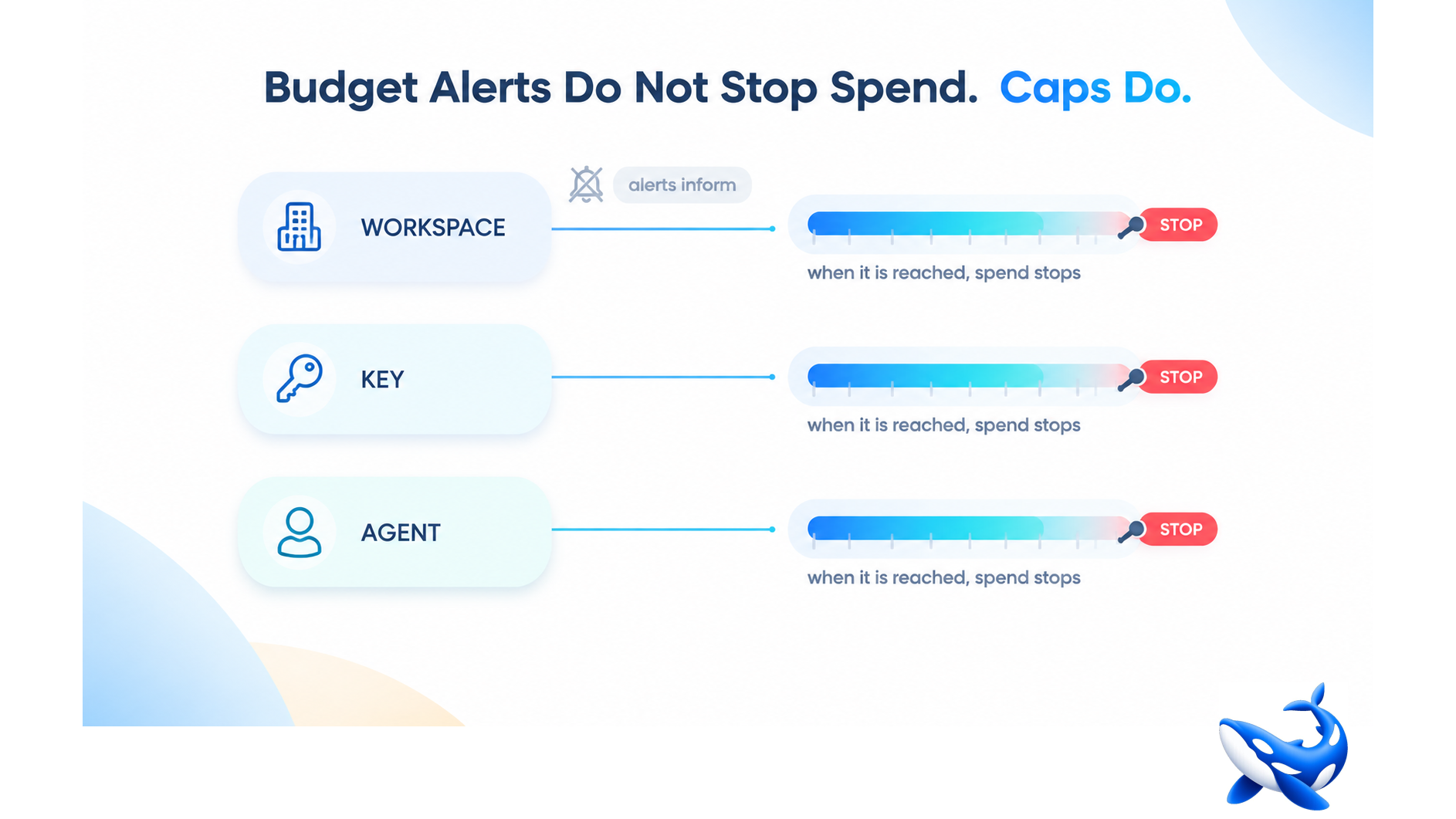
The most common sentence in gateway purchasing is “we have budget alerts, so we are covered.” It is a sentence that sounds like control and is not control at all, because an alert and a cap are different verbs. An alert informs you that spend happened; a cap decides that spend stops. The budgets-and-roles page from OrcaRouter opens by naming the thing that actually stops money — hard spend caps with an audit trail — and the detail worth reading is that budgets and roles are described in the same sentence as the record that proves what was set, which is precisely what alerts never give you.
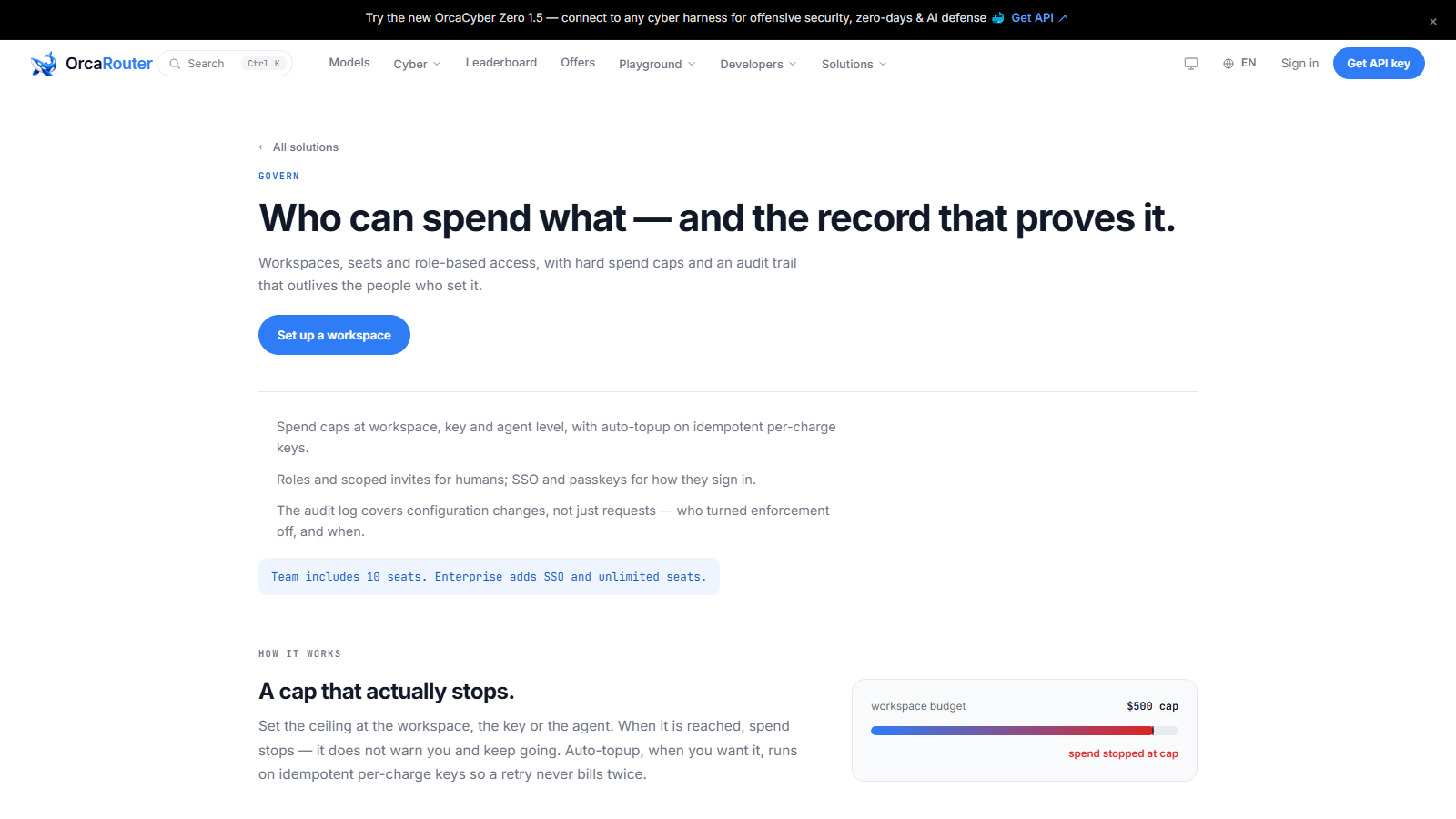
The page says what the cap is made of in one line: spend caps at workspace, key and agent level, with auto-topup on idempotent per-charge keys [OURS]. A short sentence doing three jobs — three levels of cap, a topping-up mechanism, and a billing property that makes the top-up safe. Each is worth taking apart, because together they are the difference between a dashboard that tells you bad news and a system that never lets the bad news happen.
An alert and a cap are different verbs
An alert says “you are spending.” A cap says “you are not going any further.” Only one of them controls anything. The page states its own version of the thesis in a single sentence: “When it is reached, spend stops — it does not warn you and keep going.” [OURS]
Read that sentence for what it rejects. The alternative it describes — warn and keep going — is exactly what alerts do, and it is exactly the wrong behaviour for the moment when money is being lost. An out-of-control script does not read alerts. A runaway loop does not pause because an email arrived. A contractor whose batch job has a bug does not notice a Slack notification while the job is still billed by the minute. The cap is the difference between finding out after the month that a key spent twice its allowance and knowing in advance that it cannot. One is a post-mortem; the other is a design constraint.
Three levels, three ways of losing control
The caps hang on three objects, and the objects map onto the three ways money actually gets out of control. The workspace cap is the team’s monthly ceiling: whatever the account is used for — production, experiments, that one engineer’s side project — the sum cannot pass the ceiling you set. The key cap is the contractor’s lane: a key handed to an external person, or to a CI pipeline, or to a customer-facing integration, carries its own ceiling, so one bad key cannot spend the workspace’s month. The agent cap is the unattended pipeline: a background job that runs overnight, or an agent that makes hundreds of calls in a session, has its own stop so that a loop can consume a budget rather than the company’s.
The page presents the three levels as a single feature, but they are three different contracts. The workspace cap is a promise to finance. The key cap is a promise to a counter-party — this is the most you can spend, no more. The agent cap is a promise to yourself about unattended behaviour. When the level is reached, the behaviour is the same at all three: spend stops [OURS].
A cap that actually stops
The mechanism sentence deserves its own pass. “When it is reached, spend stops — it does not warn you and keep going.” [OURS] The em dash is not decoration; it is the contrast. Most systems warn and keep going, because warning is easy and stopping is hard — stopping requires the spend path itself to check the ceiling before each charge, not after. That is what a hard cap is: the ceiling is checked at request time, and a request that would cross it is refused.
Then there is auto-topup, and this is where the design gets interesting. Topup sounds like the opposite of a cap — money being added automatically. The page makes the safety property explicit: auto-topup runs on idempotent per-charge keys, so a retry never bills twice [OURS]. Idempotent here is doing the real work. A retry of a request that already succeeded would, on a naive billing path, be charged twice; the per-charge key is what tells the system “this exact charge already went through” so the retry is free. Without that property, auto-topup would be a way to spend a budget faster, not a way to keep a service alive. With it, a transient provider error retries without double-billing, and the cap still holds because the topped-up charges are exactly the ones that were never billed before.
The record outlives the team
The second half of the page is the record, and it covers something most audit logs do not. The audit log covers configuration changes, not just requests — who turned enforcement off, and when [OURS]. A request log tells you what the system did. A configuration audit tells you who changed the rules that the system then followed — which is the question you actually ask after a bad month.
The page’s own version of the question is sharper than a generic “who did this”: “who raised this key’s cap 10x, and when?” [OURS] That is the kind of question no request log can answer, because the spending was fine after the change; the cap itself was the thing that moved. A cap that can be raised without a trace is a cap that never really existed. The configuration audit is what makes the cap durable past the people who set it — the record outlives the team, as the page puts it, for as long as the retention window keeps it [OURS].
Caps are not a paid-tier feature
The obvious suspicion about a feature like this is that the hard cap is an upsell — that free tiers get the alert and paid tiers get the stop. The pricing page says the opposite. The Hacker tier is free forever, ships ten API keys at 0% token markup, and the plans differ in seats, key count and support, not in whether spend can be capped [OURS]. The Team plan is $499 per month, still at zero token markup, and the Enterprise tier is custom pricing with a 99.99% uptime SLA [OURS]. None of the plan copy conditions a hard cap on paying for it.
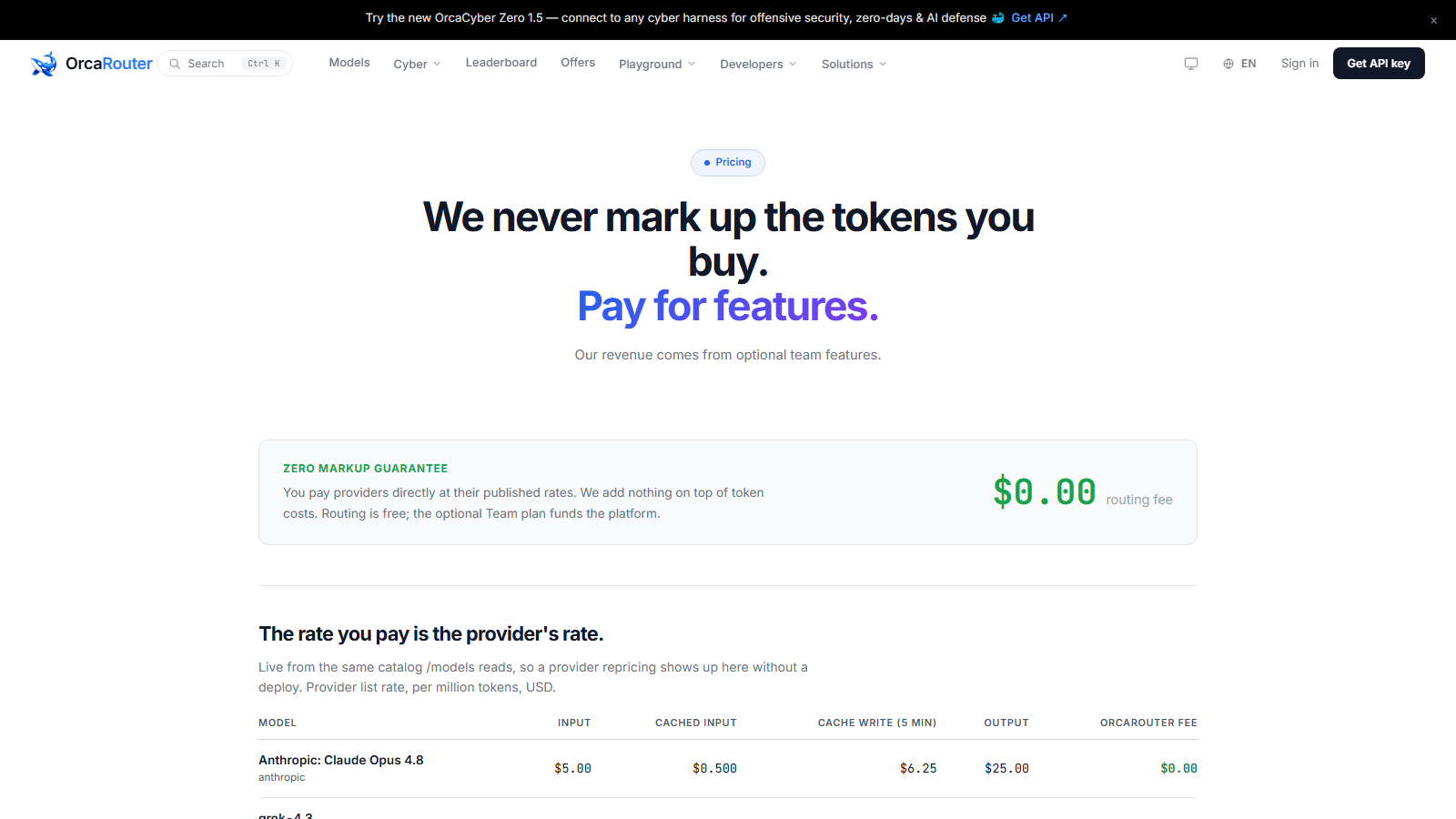
That matters for a purchasing decision, because spend control is usually wanted by the team that is small enough to worry most about a single runaway script and small enough to live on the free tier. The structure is a deliberate inversion of the freemium trap: the thing that protects your money is not the thing they charge for. The routing fee on the pricing page is $0.00 [OURS]; the product is funded by subscriptions for seats, compliance and support, not by a margin on the tokens you route or a ransom on the caps that stop them.
The takeaway
An alert is a message. A cap is a decision. The budgets-and-roles page is an argument that spend control means the second, applied at three levels that match the three ways money escapes — the workspace as a monthly ceiling, the key as a contractor’s lane, the agent as an unattended pipeline. The cap checks the ceiling at request time and stops, without warning first and continuing after. The topup that sounds like an exception is safe precisely because per-charge keys make retries idempotent. And the audit log covers the configuration changes, so the question “who raised the cap” has an answer. Alerts tell you the news. Caps make sure the news is never a surprise.
Sourcing note: the three-level hard spend caps, the “When it is reached, spend stops” behaviour, the idempotent per-charge auto-topup, the configuration-change audit log and the “who raised this key’s cap” example are read from OrcaRouter’s own budgets-roles page on 2026-10-15 [OURS]. The Hacker free tier, the $499 per month Team plan, the custom Enterprise pricing, the 99.99% uptime SLA and the $0.00 routing fee are read from OrcaRouter’s own pricing page on 2026-10-15 [OURS]. No third-party benchmark figures and no vendor pricing figures are used. Product copy is our own as published and will drift as the product changes. Read 2026-10-15.
