

Walk through a spinning or winding hall and the same pattern repeats along every line: dozens of motors, each driving a roller, a spindle or a take-up drum, and each expected to run for long shifts without breaking the yarn.
For decades many of these motors were switched by a simple 3 phase motor controller, a contactor and overload relay that could start and stop the motor but not change its speed. Mills now replace those starters with variable-speed drives because textile quality depends on how speed changes, and the move to a 3 phase VFD brings several kinds of benefit at once.
What a Conventional Starter Can and Cannot Do
A conventional 3 phase motor controller connects the motor to the mains directly or through a star-delta arrangement. The motor accelerates as fast as its torque allows, runs at a speed fixed by supply frequency and pole count, and stops by coasting or by a mechanical brake.
Overload relays protect the winding, and that is broadly the extent of the control. Star-delta starting lowers inrush current, but it still switches the motor between two fixed states and cannot shape the speed curve.
For many simple loads this is enough. Textile machines, however, rarely want a single speed: a winder needs different speeds as a package grows, a ring frame may run slower during doffing and faster in steady spinning, and every start applies a jolt to yarn that can break if it is pulled too hard.
Why Textile Processes Demand Variable Speed
Yarn and fabric respond to tension more than to anything else. Sudden acceleration stretches fibres beyond their strength, while uneven speed between two rollers causes slack or excessive draft.
Each stage of a mill, from carding and drawing to spinning and winding, imposes its own speed pattern on the motors that drive it. Winding adds a geometric problem, since a package that grows in diameter must turn more slowly to keep the yarn’s linear speed constant, and the motor has to follow that change continuously.
Speed thus becomes a process variable that has to be controlled, ramped and coordinated across machines. A mill that still relies on a 3 phase motor controller for such duties usually compensates with mechanical variators, pulleys or clutches, all of which wear and need adjustment, whereas an industrial VFD changes speed electronically and repeatably.
Multi-Speed Operation and Controlled Ramps
The most visible change after an upgrade is control over acceleration. A drive can bring a spindle frame up to speed over a set time, so yarn tension rises gradually instead of spiking at the moment of switching.
Multi-speed operation follows naturally: a machine can run at one speed for start-up, another for normal production and a third for doffing or knotting, selected by terminals or by a simple internal program.
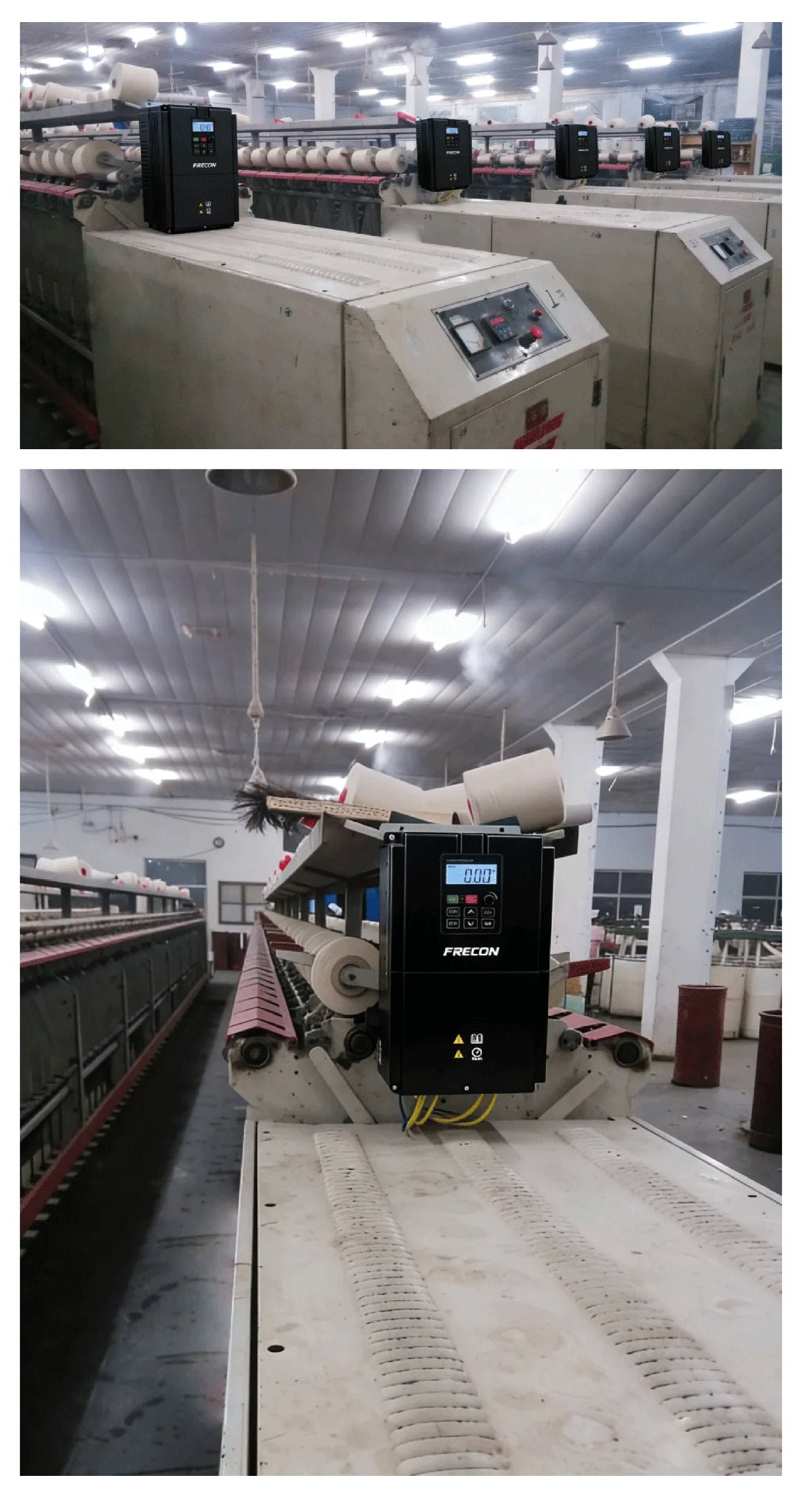
On FRECON‘s FR20 general vector inverter, ramp control comes as four acceleration and deceleration settings over 0–6000 seconds, together with up to 16 speeds selected through its simple PLC or by terminals, a jog-frequency range of 0–50 Hz, and linear, multipoint or power-law V/F curves. A 3 phase VFD with these settings can reproduce a mill’s speed sequence without the mechanical changes that the older arrangement required.
Tension Stability, Restarts and Motor Control
Steady tension also depends on what happens between speed changes. Sensorless vector control in a 3 phase VFD holds speed more closely under changing load than plain V/F operation, and FRECON’s FR20 supports V/F and two sensorless-vector modes with speed-control accuracy of ±0.5% and ±0.2% respectively, speed fluctuation of ±0.3% in sensorless-vector operation and a torque response below 10 ms. Built-in PID can close a loop around a dancer arm or tension sensor where the process needs it.
Restarts are a frequent source of breakage. Speed tracking lets the drive pick up a motor that is still coasting after a brief stop, and oscillation suppression damps the speed swings that can appear on lightly loaded rollers.
Both functions are included in the FR20, together with automatic voltage regulation, so an industrial VFD on a spinning frame can ride through the small disturbances of a busy mill without stopping the line.
Plant-Level Gains and the Reason for the Upgrade
Beyond each machine, drives change how a mill is run. Parameter upload, download and backup let one proven setting be copied across a row of identical frames, and application macros shorten commissioning. A common DC bus allows several drives to share energy, which is useful where some motors brake while others accelerate.
The FR20 range covers three-phase 380V supplies with a −15% to +30% voltage tolerance and general-duty ratings from 18.5 to 110 kW, suiting the larger motors in a textile plant such as main frame drives and ventilation fans.
Textile mills upgrade because the product demands it. Yarn quality, fewer breaks and repeatable settings all come from controlled speed, and an industrial VFD supplies that control where a starter could only switch a motor on and off.
Because FRECON’s FR20 handles ramp control, multi-speed selection, speed tracking and parameter backup on the mill’s largest motors, the quality gains reach the machines where breakage costs most.
